Overcoming Slippage and Inertia: How the VLGW12B CNC Rebar Bender Revolutionizes Stirrup Production

In the construction and rebar bending machine industry, the efficiency and precision of transforming coiled rebar into finished stirrups are critical factors that directly influence project timelines and overall structural quality.

目录

In the construction and rebar bending machine industry, the efficiency and precision of transforming coiled rebar into finished stirrups are critical factors that directly influence project timelines and overall structural quality. However, many rebar processing plants, precast factories, and construction sites still struggle with the limitations of traditional, semi-automatic bending machinery.

In recent field applications, we encountered a client heavily plagued by two chronic operational bottlenecks:

  1. Traction Slippage: When processing coiled rebar (especially 8 mm and 10 mm deformed bars), the residual twisting stress caused standard 4-wheel or 6-wheel feeding mechanisms to slip. This resulted in inaccurate length positioning and subsequent bending point misalignment, driving their scrap rate up to an unsustainable 8%–10%.

  2. Angular Inertia Deviation: When fabricating large-scale stirrups at high speeds, the bending mechanism could not brake instantly. The resulting inertial overshot created inconsistent angles between corners, forcing workers to spend substantial time on manual secondary corrections.

To break this cycle of material waste and low efficiency, we deployed the VLGW12B Automatic CNC Rebar Bender. This case study details how its specialized structural engineering eliminated these core issues, drastically boosting yield and reducing labor dependencies.

Technical Specifications at a Glance

The VLGW12B is engineered with a heavy-duty 2000 kg rigid frame and optimized dimensions ($4005 \times 1100 \times 2200\text{ mm}$) to ensure structural stability during high-intensity, continuous operations.

Feature / Parameter Specification
Max Processing Capacity Single line: 13 mm rebar; Double line: 10 mm rebar
Custom Specification Cap 3 lines of 4–6 mm rebar
Max Feeding/Tracking Speed 110 m/min
Max Bending Speed 1200°/s
Bending Angle Range ±180° (Supports forward and reverse bending)
Straightening System 14 horizontal & 17 vertical straightening wheels
Control System High-end PLC + Touch Screen + Servo Drive Control
Cutting Mechanism Motor 4.5 kW Permanent Magnet Synchronous Servo Motor
Pneumatic Pressure Requirement ≥ 0.7 MPa
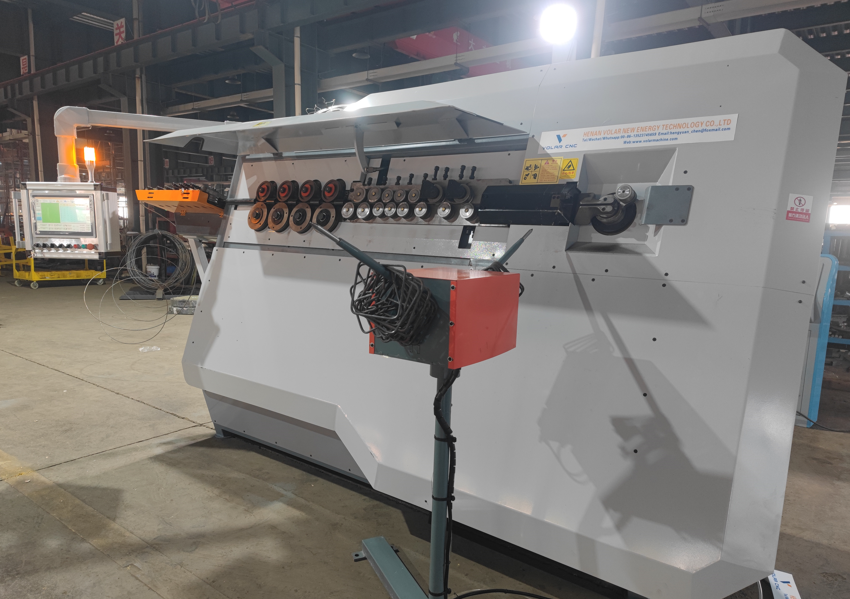
Frame Dimensions 4005 × 1100 × 2200 mm
Frame Weight/Type 2000 kg rigid frame


Core Technical Breakthroughs of the VLGW12B

1. Industry-Exclusive “8-Wheel Traction” System Eliminates Slippage

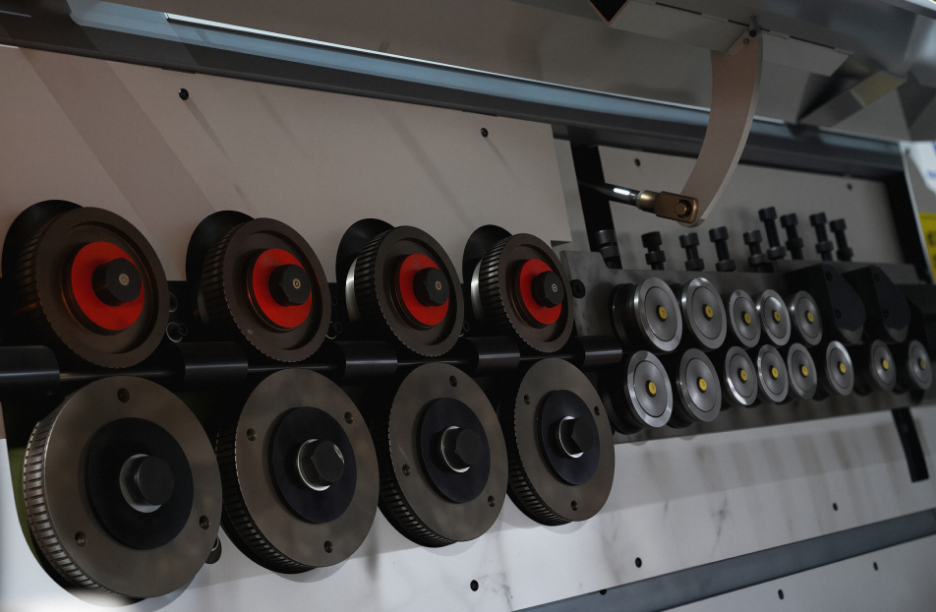
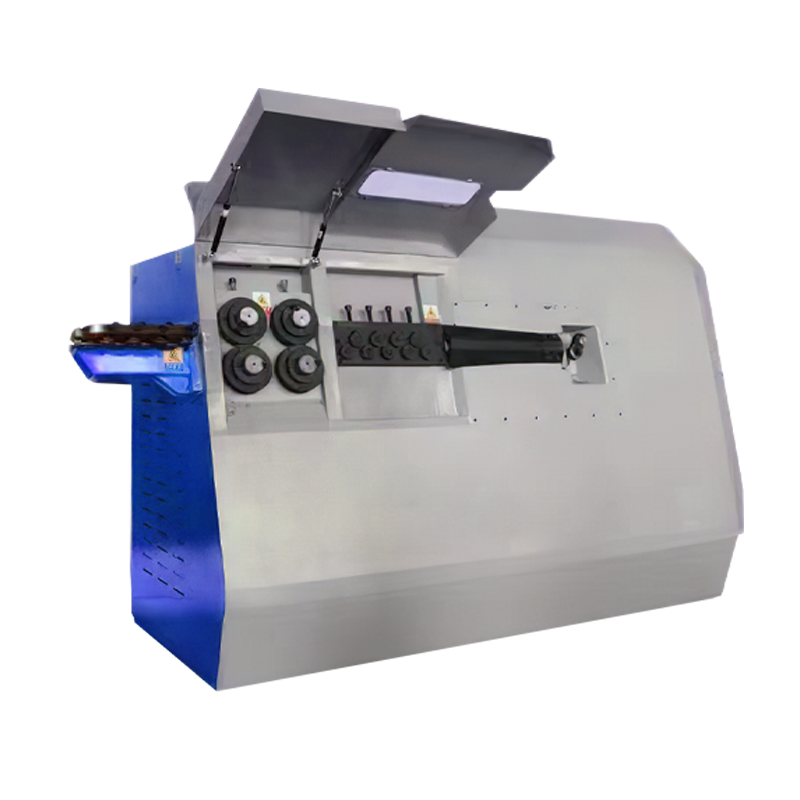
The definitive highlight of the VLGW12B is its proprietary 8-wheel traction mechanism, an industry-exclusive engineering design.

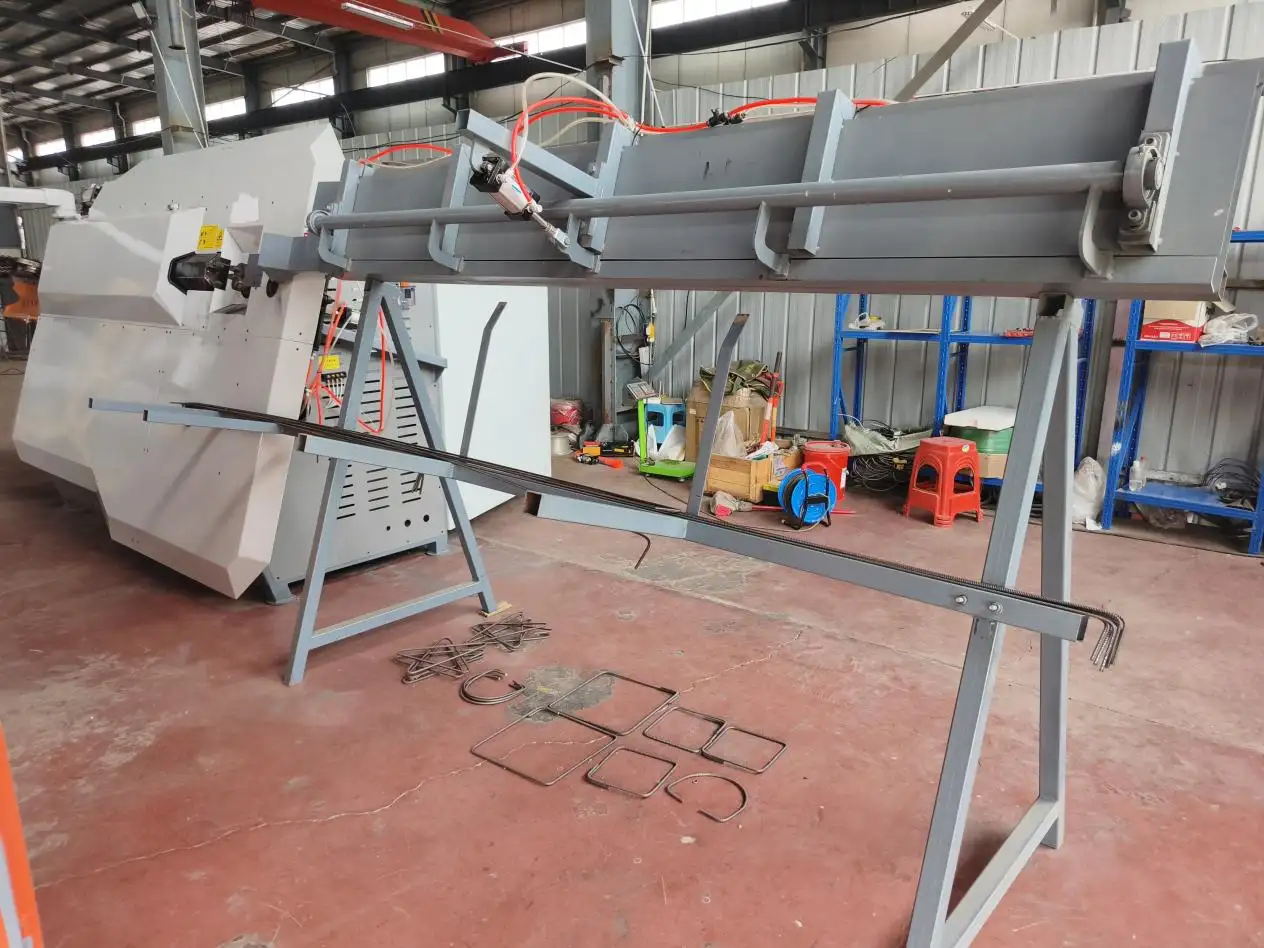
VLGW12B CNC rebar bender machine featuring an exclusive 8-wheel traction and straightening mechanism for slip-free feeding.

While typical market alternatives rely on 4 or 6 traction wheels, this heavy-duty rebar bender machine utilizes 8 high-wear-resistance traction wheels to dramatically expand the grip contact area and clamping force. No matter how severely the coiled rebar is twisted, the system securely locks and continuously feeds the stock without rotational deviation or slippage.

VLGW12B utilizes 8 high-wear-resistance traction wheels

  • The Result: Even at its maximum feeding speed of 110 m/min, the length tolerance is strictly held within $\pm 1\text{ mm}$. In on-site client trials, this advanced rebar bending machine feature alone elevated the single-take passing rate from a dismal sub-90% straight to 99.5%, guaranteeing immaculate dimensional consistency.


2. Servo + PLC Intelligent Control Eradicates Angular Inertia

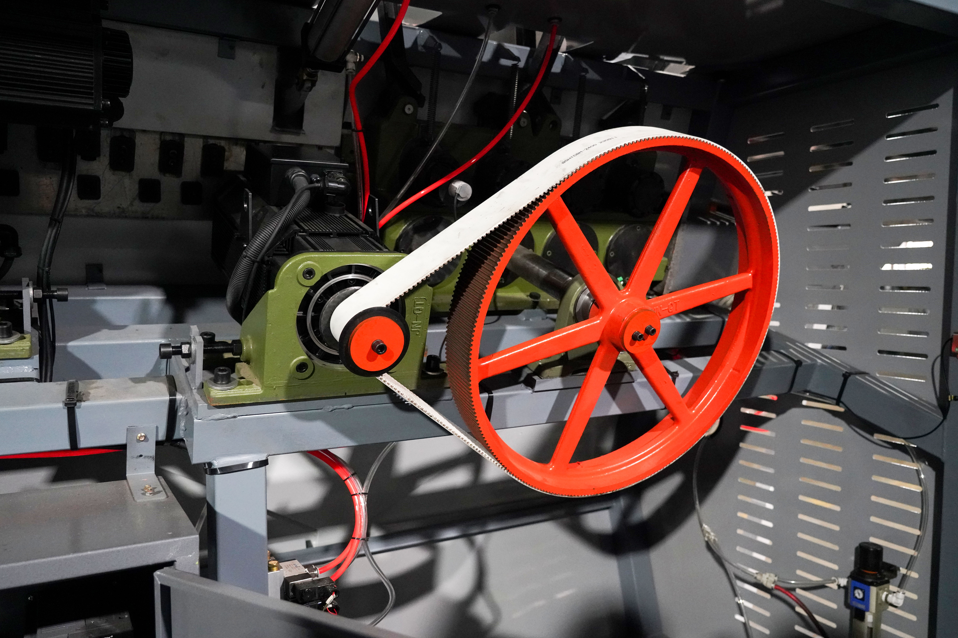
To address the overshoot issues caused by braking inertia during high-speed bends, the VLGW12B rebar bender machine implements an integrated permanent magnet synchronous servo motor and an advanced PLC automation system.

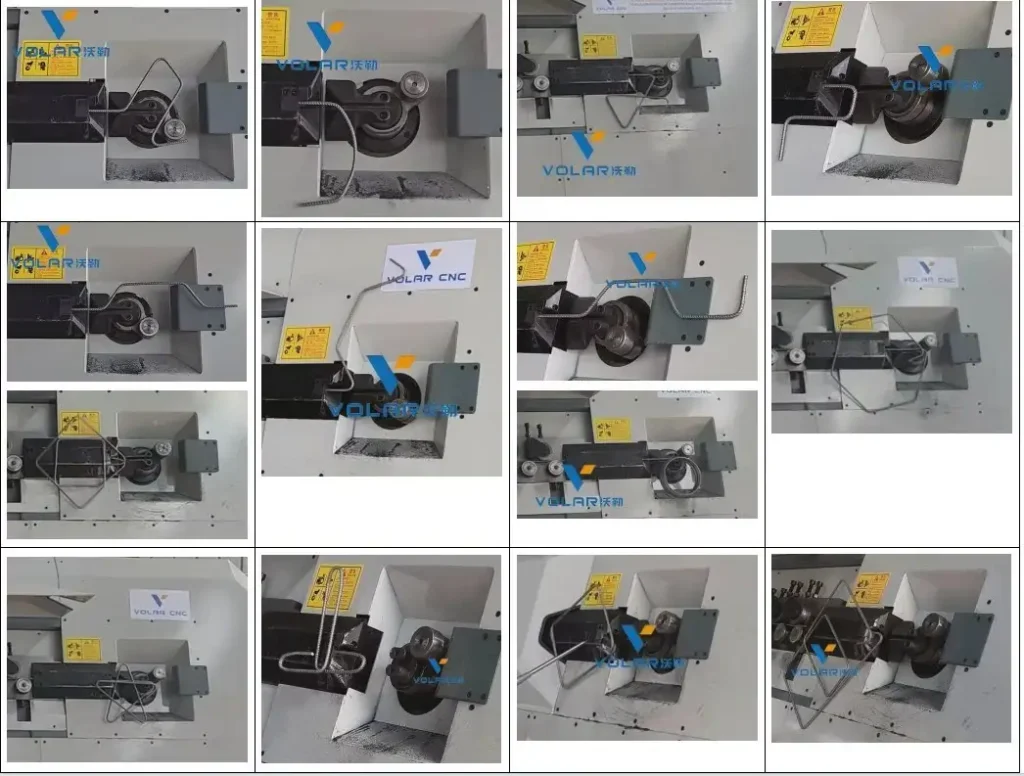
High-precision square and star-shaped rebar stirrups processed by the VLGW12B automatic rebar bending machine.

Operators can input or select from hundreds of pre-stored geometric processing shapes directly through the localized multi-language touch screen. The control system features smart automatic angle compensation. By fine-tuning the deceleration curve based on the specific stirrup leg lengths and bar diameters, the dynamic inertia is counteracted perfectly.

  • The Result: Angular deviations on this rebar bending machine are stably confined within $\pm 0.5^\circ$, completely eliminating the need for manual, post-bend adjustments and structural rework.


3. Integrated Multi-Stage Straightening & Cutting System

The VLGW12B rebar bender machine seamlessly unifies rebar pre-straightening, straightening, fixed-length measuring, bending, and cutting into a highly coordinated single-station flow.

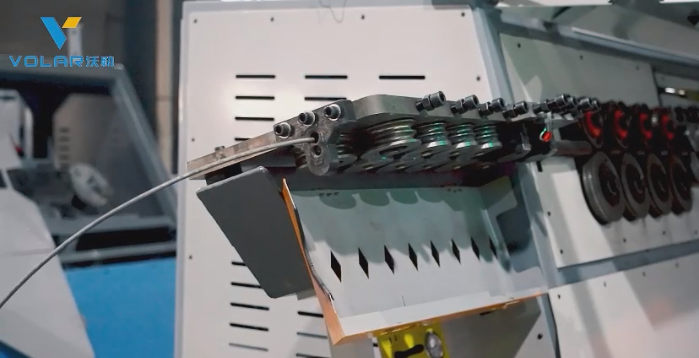
  • Premium Straightening Rig: Features an industry-top configuration of 17 vertical and 14 horizontal straightening rollers, combined with a pre-straightening module that tames high-stress coiled steel before it hits the main pullers, delivering flawless material straightness.

  • Wear-Free Cutting: Driven by a 4.5 kW permanent magnet synchronous servo cutting mechanism, the system executes rapid, continuous cuts. Because it replaces old mechanical clutches, it eliminates mechanical wear, boasts high temperature tolerance, and provides a $2.5\times$ overload torque capacity.


Global Supply Chain Integration for Peak Durability

To guarantee that this premium rebar bending machine can withstand grueling 22-hour daily shifts in extreme environmental conditions (such as unventilated workshops exceeding 40°C), the VLGW12B relies strictly on world-class, premium-tier components:

  • Bending & Feeding Drives: Premium permanent magnet synchronous servo motors supplied by Guangdong Ailesi Motor Co., Ltd.

  • Pneumatic Components: Heavy-duty systems engineered by Taiwan Airtac Industrial Co., Ltd.

  • Electrical Safety: Circuit breakers, contactors, and push buttons sourced from global leaders Schneider Electric (France) and LS Electric (South Korea).

  • Precision Encoders & Bearings: High-resolution encoders from SICK Maihak and durable telescoping bearings from Italy’s Cisiv.

  • Heavy-Duty Mandrels: All operational bending shafts are manufactured from 40Cr alloy steel by Shagang Group, subjected to rigorous heat treatment and deep quenching to prevent deformation.

Close-up of the industry-exclusive 8-wheel traction and pre-straightening mechanism on the VLGW12B CNC rebar bending machine, processing coiled steel wire without slippage

Client Outcome: Slashing Labor Costs by 60%

After three months of uninterrupted, full-capacity deployment on the client’s shop floor, the VLGW12B has registered zero mechanical failures.

When processing 10 mm deformed bars in dual-line mode, the machine consistently pumps out 1,800 stirrups per hour (averaging 15 standard $200 \times 200\text{ mm}$ stirrups per minute). Because the entire workflow from coil to final stack is fully automated, one single operator can comfortably manage the loading and unloading tasks that previously required three workers.

By cutting active labor requirements by 60%, eliminating material scrap, and providing unparalleled dimensional precision, the client has successfully optimized their operational bottom line and finalized plans to integrate multiple additional rebar bending machine units into their upcoming production lines.

Multiple-standard-stirrup-shape-templates-and-bending-patterns-of-CNC-stirrup-bending-machine

Industry Resources & Links


发送询问

请在浏览器中启用JavaScript来完成此表单。